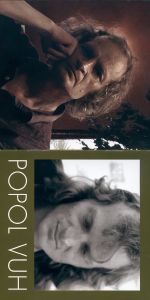
Popol Vuh - Affenstunde (1970/2004 Remastered Expanded Edition)
--------------------------------------------------------------------------------
Album: Popol Vuh - Affenstunde (Remastered Expanded Edition)
Released: 1970 (2004)
Genre: Krautrock
SPV 085-70102
The debut album from 1971 by this legendary German group who were pioneers in blending electronic muisc with ethnic sounds and trippy psychedelia. This first album is a wonderful album loaded with moogs, ethnic percussion and waves of cosmic sound. Recommended! High quality digipak, 12 page colour booklet and including a formerly unreleased bonus track "Train Through Time". - Freak Emporium
Led by keyboardist and composer Florian Fricke, Popol Vuh are one of the most unique-sounding bands in the history of progressive rock. To be fair, only a part of their output could be regarded as "rock", rather a lot of their work could be seen as pioneering in such genres as electronic, ethnic or New Age music...
...One of the very best German bands, that exemplified "cosmic music" in its myriad of forms. Earlier stuff (Affenstunde, In Den Garten Pharao) is spacey and ethnic almost electronic music. Hosianna Mantra is close in style with ethereal and uplifting female vocals. My favorites, though, are the mid seventies albums like Seligpreisungen or Einsjager and Sibenjager This music is undeniably classic with spacy guitar/piano/percussion jams that spiral and reach amazing crescendos. And is always beautiful. Very peaceful and mesmerizing... - New Gibraltar Encyclopedia Of Progressive Rock
Florian Fricke was born by Lake Constance in 1944. From 1959 till 1963 he studied music in Munich, where he was a pupil of Rudolph Hindemith (Paul Hindemith's brother). At the age of 25 he became acquainted with the Moog synthsizer which leads him to form his band POPOL VUH. This name and inspiration come from the holy book of Guatemala's Quiche Indians. Historically, Popol Vuh's "Affestunde" (1970) is the first experimental rock release entirely built around the Moog Synthesiser (with the add of percussions to provide a mystical flavour).
In 1971, their second album "In Den Garten Pharaos" keeps on fusing ambient electronic textures with traditional, ethnic instruments, but put the stress on spiritual themes. In 1972, "Hosianna Mantra" marked a turning point in POPOL VUH career by rejecting electronic instrumentations in favour of acoustic elements including a lot of oboe, konga, tamboura accompaniment and female vocals (the Japanese soprano Djong Yun and later Renate Knaup, front woman of AMON DUUL II)
In 1974, after the departure of the guitarist Conny Veit (the founder of GILA), Daniel Fichelscher (former drummer of AMON DUUL II) becomes an active member of POPOL VUH ethereal and spiritual adventure. Florian Frike's POPOL VUH was also known from a larger audience thanks to the collaboration with the German director Werner Herzog, providing the soundtracks of many of his classic films, notably the hypnotic and reflective "Aguire, Wrath of God", "Heart of Glass"...In 1978, Florian Fricke founded the "working group for creative singing" and became a member of the society of breathing therapy. He holds lectures all over the world on his work in this field. - ProgArchives.com
This was the mighty Popol’s first album and might rank as one of the most cosmic headphone experience albums of all time. Of course this is a good thing ! Affenstunde spends much of its time in the astral cockpit with the Hal 5000 and really does feel like one is in the shuttle in the depths of space. Dream part 5 is a percussionists wet dream with some pretty amazing and yet totally spacey percussion. Affenstunde was essentially the first album by Florian Fricke in the form of Popol Vuh and ranks as one of the most mezmorizing of all albums in my collection. Really sounds like early KRAFTWERK meets KLAUS SCHULZE meets the space shuttle Discovery. This is one fine album to toss onto the stereo when you need to totally veg and get your mind elsewhere for a while. - James Unger
This is the very first album by one of the stalwarts of the Krautrock scene. Popol Vuh was also one of the most uniquely sounding bands under that broad taxonomy, and they went through several stages in their career. However, this debut, whose title means "Monkeys' Hour" (or perhaps "Happy Hour"?), is as embryonic as one could get for a debut. Basically, it's Fricke fiddling with a moog synthesizer - one of the gigantic, early models, too - throughout the length of the album, invariably with mild synth processing or fervently played bongos. It stands pretty much alone in the band's canon, its nearest companion being their next release, In Den Garten Pharaos. It is far from the melodic, 'classic' sound in which they would immerse themselves a mere 2-3 years laters. I find it pretty bland comparatively, being amelodic, atonal, and when the bongos aren't playing (and even sometimes when they are), arhythmic on top of that. This is pretty much only for Krautheads of the extreme sort, who lavish their unconditional positive regard on the early, unpolished stuff by all these bands - Joe McGlinchey, Ground and Sky review - Popol Vuh - Affenstunde
Impressive debut with a mysterious, religious, weird electronic album about human being, where man becomes man. Florian Fricke experiments the opportunities of the Moog synth to create a whole album around atmospheric, strange electronic effects. The result is unique and the approach was new in popular music. The “Dream” series are enigmatic titles, a manifesto of experimental sounds treated by the “electronic”. The first track starts with concrete noises taken from the nature, then comes bizarre long continuous forms augmented by circular “cosmic” sounds. The second track directly follows the previous composition without any transition. Frantic “ethnic” drums dominates the tune, it’s purely shamanistic.” Dream part 3” delivers abstracted, meditative, scary sounds produced by the Moog synth (very closed to the seminal “zeit” by TD). “Affenstunde” is absolutely magic; a captivating “ethnic” composition which provides an immersive dialogue between possessed acoustic percussions and electronic loops, textured patterns. The second part of the tune reminds me Terry Riley’s “Persian surgery dervishes” with its endless hypnotic organ loops. The bonus track ("train through time") on the SPV reissue is a powerful, percussive / repetitive track which progressively meditatizes the listener. The track has similar psycho-acoustic effects than Gottsching’s marvellous guitar trance-like work in his “inventions”. To sum up things Affenstunde is milestone in progressive electronic music, culminating at the top of the most creative rock albums of the last century. - Philippe Blache, ProgArchives.com
The earliest incarnation of Popol Vuh may have been the most pioneering version of the group, but their debut album Affenstunde is certainly a far cry from classic later albums like Einsjager & Siebenjager or Seligpreisung, stylistically. Depending on who you ask, this version of Popol Vuh was either the only one that really mattered, or simply a befuddled, overly ambitious stage to be left for completists only. Indeed, Florian Fricke is often cited as one of the pioneers of the Moog synthesizer, and those familiar exclusively with this later, piano-based work may have been wondering why. To be sure, Affenstunde and its more successful follow-up, In den Garten Pharaos, feature plenty of experimentation with the instrument, for better or for worse.
So is it any good? Well, it's successful in points, but somewhat over stretched and inconsistent in others. As expected, much of the album is dominated by Fricke and his cohorts futzing around with monophonic synthesizer pulses, beeps, whizzes, whirs and, occasionally, discernible melodies. Behind this are walls of wan, cavernous electronic sound. Some of the most rewarding moments come about when an active rhythmic base is established by a frenetic percussion player banging away on hand drums and bongos. The opening minutes of the title track, for example, feature this exciting backdrop, over which a repetitive synthesizer motif rumbles along, complemented by ghastly, inhuman howling sounds of an unknown origin. Haunting. Overall though, the album presents a kind of vision that would be matured and ultimately perfected on the next album, In den Garten Pharaos, towards which all potential early Popol Vuh cosmonauts are hereby directed. - Greg Northrup, ProgWeed.net
This is the beginning of one of the big names of the Krautrock movement. This is one album you can't go by from their better-known piano-dominated albums like Hosianna Mantra” and those following. Instead this dates back when Florian Fricke had little problems messing around with synthesizers, and this, their debut, proves. This album was originally released on Liberty Records. The album features two side-length cuts, the first being "Ich Mache Einen Spiegel". It starts off with lots of strange computerized sounds and strange droning sounds. Then you go in to percussion overdrive, before the "music" (if you want to call it that) mellows out with simply droning sounds. Then you have the title track which is full of sounds of traffic before it's taken over by even more droning sounds, only this time, the percussion kicks in and Florian Fricke starts messing about with some cheesy sounds off his Moog (making it almost sound like computer video games against a droning background, even if video games were unheard of when “Affenstunde” came out).
The back cover features pictures of hippies playing along (in reality, Florian Fricke playing his Moog, as well as Frank Fiedler, and non-member, but producer Bettina Fricke on percussion - by the way I'm not certain how Bettina is related to Florian). Bettina Fricke looks most like the stereotypical hippie complete with headband and flowery clothing (she looks like an escapee of San Francisco's Haight-Ashbury scene). Often this album gets compared to early TAANGERINE DREAM, which like what they have done, little, if anything, features any sort of melody or tune, just lots of atonal experiments (and of course bringing up TANGERINE DREAM only makes since since in 1972, Florian Fricke did guest on “Zeit”). If you're familiar with only POPOL VUH's piano-dominated stuff, post- 1972, be utterly shocked with “Affenstunde”. I only wished Florian kept on using synthesizers, he only used them one more time on “In den Garten Pharaos” before his religious conversion (to Christianity and Hinduism) strangely compelled him to suddenly hate synthesizers and turn to the piano (although be aware that parts of “Aguirre” dates back to the “In den Garten Pharaos” sessions). As for “Affenstunde”, love it or hate it, but if you like off the wall experimental electronic music, you're certain to like this. - ProgArchives.com
1. Ich mache einen Spiegel:
...1) Dream part 4 - 8:44
...2) Dream part 5 - 4:41
...3) Dream part 49 - 7:43
2. Affenstunde - 18:30
Bonus Track:
Train Through Time - 10:30
Florian Fricke - Moog synthesizer
Frank Fiedler - synthesizers, mixdown
Holger Trülzsch - percussion
|