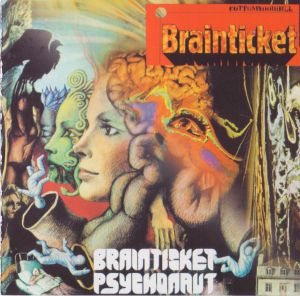
Brainticket - Cottonwoodhill & Psychonaut (1971-72/2002 Redfox Records Remastered 2 in 1 CD)
--------------------------------------------------------------------------------
Artist: Brainticket
Album: Cottonwoodhill & Psychonaut (2 in 1 CD)
Released: 1971-72/2002
Genre: Krautrock, Psych/Space-Rock, Experimental
An absolute must-have two-fer CD release by the Swiss space {tripping} rockers none other than Brainticket. Although some have been led to believe this band was a krautrock ensemble from Germany, they're actually Swiss. Here you get two priceless pieces of early seventies progressive space rock, Brainticket's first two efforts, 'Cottonwood Hill' {'71} and 'Psychonaut' {'72} where I've always dug a bit more so than their first album. Tunes off this 2nd release that make the two-for a 'to die for' disc are the ethnic folk-like "Radagacuca", the rocking "Watchin' You" and "Coco Mary". Founder Joel Vandroogenbroeck's organ playing is Brainticket's main asset. 110% essential. - Mike Reed, Amazon.
Brainticket was one of those groups never known for a steady lineup, and even their nationality was purposily obscured thanks to a multi-national lineup. Joel Vandroogenbroek was the leader of this group. Many people thought this group was Dutch because of Joel's name, but actually he was born in Belgium (in the Flanders region where the Flemish variety of Dutch is spoken). Many people think they were Swiss because they resided in Switzerland. And then they get considered Krautrock because they have all the elements of the German scene of the time. OK so this is a package of their first two albums. First one being Cottonwoodhill, originally released on the Hallelujah label. "Black Sand" and "Places of Light" are nice, pleasant organ-driven numbers with Dawn Muir giving us some spoken dialog. The rest of the album is consumed by "Brainticket Part 1 & 2". This is based on a repetitive organ riff with lots of bizarre sounds effects, as well as sounds of motor vehicles, crowds, and Dawn Muir tripping out real bad. How did an album like this get released? I don't know, but what I do know is there's two warnings on this album that go: "Listen only once a day to this album. Your brain might be destroyed" and "After listening to this album, your friends won't know you anymore". Yes, it's a really disturbing album, so they didn't put up that warning just for fun. It's also thanks to this warning, and the musical content that caused the album to be banned in many countries (like Spain and Portugal, where they were under dictatorships, and I'm more certain, the communist countries). Not the kind of album you want your next door neighbors to hearing (because you have it cranked too loud), especially if that next door neighbor is a Lawrence Welk devotee or watches The 700 Club on a regular basis. 1972's Psychonaut, originally released on the German Bellaphon label seems like Cottonwoodhill's polar opposite. Except for Joel himself, the band had a complete change in the lineup. Most importantly is drummer/percussionist Barney Palm who will be on all the following Brainticket albums (including their early '80s reunion efforts, Adventure and Voyage). Here the band actually focuses on music, making it a song-based album, but still keeping a psychedelic edge, especially with the strong ethnic bent (sitars, tablas, and various ethnic instruments used along the usual rock instruments). "Radagacuca" is that opening cut, with droning organ, percussion, sitar, and then when the vocals kick in, you can tell they were actually concerned with creating some catchy songs, but hardly selling out. "One Morning" is a great little song with nice use of piano and strange percussion. "Watchin' You" really rocks out big time with nice female vocals, with an unexpected twist at the end, with sitar and organ. "Like a Place in the Sun" features spoken dialog from Carole Muriel (new to this album, and would appear on their 1973 followup Celestial Ocean), and the band tries to be heavier here with heavily fuzzed organ. "Feel the Wind Blow" is a pleasant acoustic number with a psychedelic feel. "Coc'o Mary" is the album's closing piece and is instrumental and sounds very much like Jethro Tull meets Santana, with Tull-like flute and Santana-like percussion. Psychonaut is one of those progressive rock albums that still show their psychedelic roots, in fact this only proves how much that kind of music had their roots in psychedelia, and that prog rock often still kept their psychedelic roots intact as late as 1972, as this album proves. Two great and fascinating albums, really hard to believe it's by the same group (because technically it wasn't thanks to an almost completely different set of musicians involved in both). - Benjamin Miller, Amazon.
Cottonwood Hill AMG Review: Cottonwoodhill is one of the trippiest records ever made, capturing the intensity of the peak LSD experience far more successfully than any Timothy Leary recording, and even today, when many such documents from that era can sound silly and dated, Brainticket's fascinating debut still holds hallucinogenic potency. The record has only two proper songs, "Black Sand" and "Places of Light," with a side and a half of the album taken up by the three-part "Brainticket." "Black Sand" opens the disc with a driving funk beat and powerful organ and guitar interplay, adding in vocals distorted beyond coherency. "Places of Light" begins in a slightly lighter vein as a flute leads the proceedings, a looser jazzier piece that throws in some of Dawn Muir's odd spoken word vocals. Before one realizes what has happened, the piece has faded out and there is suddenly a crashing sound, car horns, and engines starting up. "Brainticket" is a bizarre roller coaster ride through weird sound effects and electronics, an endless organ riff, and Muir's acid-rush ramblings from hushed whisper to urgent screams, as any coherency she had earlier becomes lost to mind-expanding visions. Rather than the laid-back mellow groove of some psychedelic music from this era, Cottonwoodhill has a hyper energy in the frenetic organ riff and Muir's voice, like an acid trip out of control, while at times the various sound effects take over completely. - Rolf Semprebon.
Psychonaut AMG Review: Psychonaut is more relaxed and has far less electronic elements than either Brainticket's first record, Cottonwoodhill, or the album that followed, Celestial Ocean. Though the record is more straightforward and song-oriented, it still has progressive and experimental elements that keep it from sounding too much like anything else. If anything, the group is not quite focused on any one style on this record, throwing in everything from the ethnic-influenced folk of "Radagacuca" and "One Morning" to the more traditional strummy folk of "Feel the Wind Blow" to the percussion-heavy avant-funk instrumental "Cocò Mary" to the quirky rock assaults of "Watchin' You" and "Like a Place in the Sun." "Like a Place in the Sun" is particularly effective, with dark spoken word vocals alternating in contrast with the sung chorus of its title. Effects and electronics are used much more subtly (especially compared to the earlier record), but are still quite evident. Psychonaut may not be as cohesive as the other early Brainticket albums, but it is also not as chaotic either, and as such may be the group's most accessible record without sacrificing originality. - Rolf Semprebon.
Musicians:
Cottowoodhill: Ron Bryer (guitar), Werni Froehlich (bass), Hellmuth Kolbe (potentiometers, generators, sound effects), Cosimo Lampis (drums), Dawn Muir (voice), Wolfgang Paap (tabla), Joël Vandroogenbroeck (organ, flute)
Psychonaut: Jane Free (vocals, tbilat, tambourine, slide whistle, sounds), Joël Vandroogenbroeck (organ, piano, flute, sitar, vocals, generator), Rolf Hug (guitars, tablas, vocals), Martin Sacher (bass, flute), Barney Palm (drums, percussion, sounds), + Carole Muriel (voices)
|