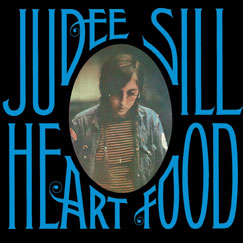
Judee Sill - Heart Food
01 - There's A Rugged Road
02 - The Kiss
03 - The Pearl
04 - Down Where The Valley's Are Low
05 - The Vigilante
06 - Soldier Of The Heart
07 - The Phoenix
08 - When The Bridegroom Comes
09 - The Donor
10 - Jig
Bonus Tracks
11 - The Desperado
12 - The Kiss (solo)
13 - Down Where The Valley's Are Low (solo)
14 - The Donor (solo)
15 - Soldier Of The Heart (solo)
16 - The Phoenix (solo)
17 - The Vigilante (solo)
18 - The Pearl (solo)
19 - There's A Rugged Road (solo)
Tracks 1-10: from the album 'Heart Food' released on Asylum in 1973
Track 11: outtake from 'Heart Food' sessions
Tracks 12-19: solo demos for 'Heart Food'
Taken from the CD on Rhino Handmade
AMG Biography by Alex Stimmel
A singer/songwriter with deeply religious overtones and a penchant for the occult, Judee Sill is one of rock's more interesting and lesser-known stories. The daughter of old Hollywood money, Sill's father died when she was just a child, and her brother died in a car crash soon after, leading to a bleak outlook on life that she expressed in an arty, disaffected attitude. She disliked her stepfather and condemned her mother for remarrying; as a quiet form of vengeance, Sill set out to travel America and live a rambling lifestyle. She had been interested in playing music although was seemingly not serious about it until she began her travels, playing small coffee houses and dives for fun. She and her friends had always been into drugs for recreational and exploratory use, but as Sill stayed out on the road she began using heroin regularly, eventually developing a hundred-fifty-dollar-a-day habit. It was rumored (partly by Sill herself, although never confirmed) that she at one time had to prostitute herself in order to support her addiction.
In the late '60s Sill was busted for heroin possession and served three months in prison, during which time she was able to kick her habit; when she returned to the world at large, she focused solely on making music. She returned to Los Angeles where, through her Hollywood connections, she was introduced to David Geffen. Geffen was in the process of creating Asylum Records, which was to focus exclusively on non-rock material. Taken by Sill's abilities as a writer and performer, Geffen immediately signed her to Asylum; her self-titled debut was also the first official release for the new label.
It was through Geffen that she met Graham Nash, who quickly became a fan, and produced the first single for her album, "Jesus Was a Cross Maker." The rest of Judee Sill was orchestrated and produced by Bob Harris, Sill's ex-husband. Judee Sill was released in 1971 to immediate acclaim. Lushly orchestrated, the album featured Sill's voice in multiple overdubs, often in a four-part chorale or fugue. The album fit in well with the light rock/folk-rock underpinnings of what came to be known as the "Laurel Canyon sound" associated with other female singer/songwriters such as Carole King and Joni Mitchell (Mitchell, also signed to Asylum, was at work on Ladies of the Canyon at the time, which was also produced by Bob Harris). A tour as the opening act for Nash and David Crosby exposed her intimate songwriting and skillful guitar playing to a larger audience, but her record failed to make much of an impact, despite the somewhat heavy airplay of "Jesus Was a Cross Maker." A self-professed perfectionist, one song could often take her a year to write, and it wasn't until late 1972 that Sill returned to record and release her second and last album, Heart Food. It too received enthusiastic reviews but did poorly commercially. Sill took over the chores of both orchestrating and arranging Heart Food, with the production relying more heavily on multilayered strings and lush expanse. Unable to draw a sizable crowd yet unwilling to play as a support act, Sill's name and moderate fame both receded, and she disappeared from view entirely. Rumors abound as to what happened next, although it is definitely known that she returned to her heroin addiction as well as becoming heavily involved with cocaine. Graham Nash has said that he learned as early as 1974 that Sill had died of an overdose, a claim that would later prove to be incorrect, but considering how closely the two had worked only a few years earlier it does illustrate just how completely Sill had dropped out by this time. She never managed a second return from the abyss and Judee Sill, age 35, died of a drug overdose in November of 1979.
AMG Review by Alex Stimmel
The second album Judee Sill made proved to be her last. A notoriously slow songwriter, this brief though enjoyable outing took its toll on Sill during its making, turning her back to her recently kicked heroin addiction and away from the desire to create more music. Instead of using an outside arranger for the strings (as she did on her previous album), Sill did all of the work herself. Her lack of formal training and the immense amount of orchestral overdubs certainly would have made such an outing a hardship for anyone. The album doesn't suffer much from its sometimes syrupy exterior, though -- the songs are almost as strong as any of those from her debut. To wit, Heart Food suffers only in comparison to its predecessor; otherwise, it's a stellar example of the kind of singer/songwriter fare the music industry was mining in the early '70s. The supporting cast of top L.A. studio musicians solidifies Sill's unique brand country-flavored pop, which moves from introspective meanderings to loping rock, often within a single song.
Review from Rhino Website
Judee Sill was a true original. A singer-songwriter with a wealth of influences and a fascination with religion, she referred to her work as "country-cult-baroque." She was the first artist signed to David Geffen's Asylum label, and, along with Joni Mitchell and Carole King, exemplified the breezy "Laurel Canyon Sound" of the early '70s. Sill scored moderate hits with "Lady-O" (originally written for The Turtles) and "Jesus Was A Cross Maker" and released two albums -- 1971's Judee Sill and 1973's Heart Food -- before suffering chronic pain and eventually dying of a drug overdose at age 35.
Sill grew up in Oakland, California, and began playing piano at age three. A troubled family life and brushes with the law landed her in reform school, where, as church organist, she developed the gospel style that would characterize her future recordings. After a stint in college and three down-and-out years of addiction, she cleaned up and began work on her dream of becoming a songwriter. She spent a short time penning songs for The Turtles' production company before signing her own deal with Asylum.
Pleased with the creative direction of Judee Sill, the singer-songwriter again teamed with engineer/producer Henry Lewy (Joni Mitchell, Neil Young) for her follow-up. On Heart Food, Sill's voice is stronger and Lewy's production more resonant. Built around the singer's guitar or piano, the songs are arranged with similar ambition. "There's A Rugged Road," a meditation on Christ's humanity, features country violins, pedal steel, multi-tracked vocals, and a hoofbeat rhythm. The gospel-influenced "Down Where The Valleys Are Low" burns with electric guitar, church organ, vibes, and doo-wop harmonies. The album's closing opus, "The Donor," uses male voices and tympani to build an intense medieval round.
This Rhino Handmade release of Heart Food has been remastered from original source materials and expanded with nine bonus tracks, including the studio outtake "The Desperado" and eight solo demo versions of album tracks.
|