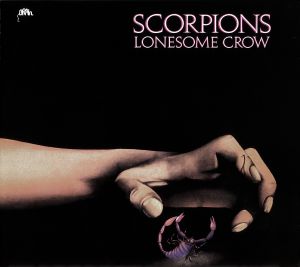
Album: Scorpions - Lonesome Crow (Remastered Edition)
Released: 1972 (2007)
Genre: Krautrock
Gnosis Rating: 10.38
Brain/Revisited Records - SPV 49562 CD
Probably the most famous of all Hannover bands, originating in 1965 as a beat group and latterly becoming a popular Heavy Metal band in the late-70's. But, don't just skip by this because you were stung by one of their later albums, as in their early days Scorpions had a different kind of sting in their tail! Yes, in the early-70's, the Scorpions were very different. With the honour of issuing the first Brain album: LONESOME CROW, they proved to be an exceptionally gifted band fronted by two very different guitarists. A varied album, of mostly psychedelic hard-rock tracks, unusual ballads, it's a creative and very progressive album, topped off by an amazing spaced-out experimental finale, a mostly instrumental extravaganza, which touches onto Guru Guru freakiness. A peak that they never reached again. Moving to RCA, FLY TO THE RAINBOW also had much excellent progressive hard-rock, with Hendrix inspired guitarist Uli Roth stepping in to replace Michael Schenker who had joined the British band UFO. But, subsequently, after the passable IN TRANCE, the Scorpions became ever more mainstream Heavy Metal, and increasingly dull. So ignore anything not listed here! Uli Roth later formed the similar (but superior) Electric Sun. - "The Crack In The Cosmic Egg"
Before drowning every inch of their credibility in a stream of commercial and crappy cheese-metal, Scorpions were probably the best German hard rock band. They formed already back in 1965 in their very early teens, but didn't release their first album before seven years later. The line-up of the band in 1972 consisted of Klaus Meine on vocals, brothers Rudolf and Michael Schenker on guitars, Wolfgang Dziony on drums and Lothar Heimberg on bass. "Lonesome Crow" was the very first album on the excellent Brain label that would release some of the best progressive rock to come from Germany. The record itself is the biggest anomaly in Scorpions' catalogue, sounding nothing like anything they would release later. The biggest influence on the album was undoubtedly early Black Sabbath, but "Lonesome Crow" is a bit more psychedelic and without the occult stuff. The opener "I'm Going Mad" pretty much sets the standard for the rest of the record, with it's heavy and doom-laden guitars and dark, 60's sounding vocal harmonies. "It All Depends" sounds extremely much like something from the two first Black Sabbath albums, and "Leave Me" features repetitive wordless vocal harmonies under Meine's wailing vocals, which by the way also were different from how he would sing on later albums. They also attempt some rather complex structures in "In Search of the Peace of Mind" and "Inheritance" and succeed quite well, especially on the latter one. "Action" has some swinging jazzy and bluesy rhythms that again bring comparisons to very early Black Sabbath. The title-track is stretched to over 13 minutes by lots of intense jamming, and the young Schenker-brothers deliver an impressive performance. I also like the way the track returns to the beginning at the end, but now slightly calmer and less heavy. "Lonesome Crow" is hopelessly misunderstood by mainstream fans of the band, and sadly overlooked by people who don't know that Scorpions actually were a good band before they became a cheesy arena act. - VintageProg.com
This well known heavy rock band is listed here mainly due to the significance of their first album Lonesome Crow (1972), released on the green Brain label. From the album's catalogue number, you will see that this was the first album on the Brain 1,000 series! Their debut was way better than those albums that brought Scorpions international fame - much more experimental and 'progressive' in sound! Their ace guitarist Michael Schenker left soon after this album for international adventures with the heavy metal group U.F.O. (their first albums were also great!). He'd met this group when Scorpions supported U.F.O.'s German-tour. This left Scorpions under the command of Klaus Meine and Rudolf Schenker, who re-launched the band with Fly To The Rainbow on RCA in 1974. Their new guitarist Ulrich Roth provided some interesting moments on their albums up to 1978. Scorpions gradually established themselves as the leading heavy metal band in Germany as their creative energy decreased and horrible «heavy ballads» (their trade mark) became their trademark - "Cosmic Dreams At Play"
When we met Conny Plank in 1971, we were young and hungry. We had only just started writing our own songs and were desperate to work with a real producer in a professional studio. Up to then, we had experienced quite a few adventures in this respect and so it was just a lucky coincidence that we met Conny, t h e groundbreaking producer of numerous important bands of the early seventies (Kraftwerk, Neu!).
We had finished the recordings for our first album Lonesome Crow within one week only, mixing included. Of course, we were aware of the fact that with Michael Schenker, we had an exceptionally talented guitarist in our band. As far as our style was concerned, rock songs (I'm Going Mad) or experimental songs (Lonesome Crow) were leading us the way. Yet as early as that, it was clearly noticeable that the band had a perfect feeling for strong rock ballads (In Search Of The Peace Of Mind).
With the 1972 release Lonesome Crow, the band not only achieved an excellent debut but also laid the foundations of an international career. Even though we have had many different line-ups in all those years, there is one thing that has remained unchanged: the spirit of the Scorpions, the friendship between Rudolf and me. - "Young And Hungry" by Klaus Meine
From Sarstedt near Hanover into the big wide world: in the mid-1980s, the Scorpions were awarded the title "Germany's number one rock export", something which they really deserved because at the height of their career, they effortlessly filled the big concert halls of the United States. Even today, they are often mentioned in one breath with bands such as Aerosmith, Van Halen and Bon Jovi. Their live shows are just terrific since the energy of the band is physically perceivable even in the last rows of sold-out arenas. The list of their hits is longer than many a music lover would dare think of: Rock You Like A Hurricane, Wind Of Change, No One Like You, Big City Nights, Can't Live Without You, The Zoo, Still Loving You, Is There Anybody Out There etc. The press praised the band for constantly "sending shivers down the back" of their delighted listeners as well as for acting "daringly" with their music.
The band's early days must have been depicted a hundred times or more. Over and over again, Rudolf Schenker is asked to give an account of how a bunch of good friends founded the amateur band Scorpions in 1965. Back then, the line-up still included Rudolf and Michael Schenker (both on guitars), Klaus Meine (vocals), Wolfgang Dziony (drums) and Lothar Heimberg (bass guitar). "A first-rate line-up of highly talented musicians" is how Schenker describes the early make-up of the band that won a record deal in a band contest in Hanover which they finally didn't sign because the overall conditions proved to be rather poor. "We were invited to a small studio in Osnabruck which was so badly equipped that the whole system was overloaded when Klaus sang I'm Going Mad. The producer tried to solve the problem by making Klaus sing into a rubbish bin in order to mute the volume. That was too much for us. We went back home and refused to sign the deal."
During recordings at the Hamburg Star Studio shortly afterwards, however, the band was discovered by Conny Plank (Kraftwerk, Neu!, Ultravox) who recommended them to the newly founded Brain label which was part of the Hamburg music group Metronome. The Scorpions were among the first bands - along with Jane and Neu! - to sign up with this label specialised in German rock music. But first, there were still some problems to be settled before their debut could be launched on the market. "The company had a somewhat strange concept for the album cover. The first design they sent us showed a guy dragging a toothbrush behind him. In response to that, we asked the company to get us a decent advertising agency which would help us implement our own ideas." In cooperation with the Hamburg agency Wandrey (they also did some artworks for Klaus Doldinger's Passport), they could finally agree on an album cover.
On 11 th February 1972, their debut Lonesome Crow was released on which the musicians presented themselves in a rather ambiguous way in terms of style. Schenker: "Our music already sounded quite American or English for its time, especially when compared to the then famous German colleagues like Can and Amon Duul. At the same time, we were still searching for our own style. Action almost had a jazzy touch, Lonesome Crow was a real rock song that was also highly experimental though. But by the time, we had already decided to do both rock songs and ballads."
The whole band participated in the creation of each of the seven pieces on the album that they had thoroughly tried and tested in their gigs beforehand. Back then, the Scorpions were above all a live band that knew how to win over their audience. Apart from that, they used their concerts as a source of inspiration. The song In Search Of The Peace Of Mind tor example was written by the Schenker brothers during a three-day stay at Meta's legendary club in Norddeich. "When Michael and I worked together composing, the songs came up automatically. We've got the same musical background, the same idols, the same point of view as far as music is concerned."
Although its sales figures (4000 copies) were quite low, the album was quite a good start and was also successful abroad. "According to our contract, the company was committed to releasing Lonesome Crow in all countries we toured, and so we deliberately played some gigs in the Netherlands, Belgium, France, Luxemburg, Austria and Switzerland in order to get our album into the record stores" The sound of the Scorpions was even appreciated in North America. "In America, the album was licensed through Billingate. And so, enthusiastic Scorpions fans started calling me from some parties at three o'clock in the morning just to tell me: It's ****ing great, man!"
Yet a short time later, substantial problems for the first time occurred. Two years after the album release, Michael Schenker left the Scorpions in order to join UFO, who had discovered the outstandingly talented 17-year-old during their tour with the Scorpions and had decided to hire him. From the very beginning, Schenker largely contributed to UFO's huge international success. Even today, the album Phenomenon (1974) - with its classics Doctor Doctor and Rock Bottom - is considered as one of the most important releases of that time. For the Scorpions, this almost meant the end. With Michael Schenker leaving the band, the initial line-up split up completely. To crown it all, the record deal, which initially was to run over the period of two albums, was terminated by Brain, something which led the musicians to fear for their existence. "We were heavily in debt because we had bought a huge PA with ten amps and twenty speakers. Of course the whole equipment was worthless without a record deal or a well-functioning band." Yet finally, Rudolf Schenker and Klaus Meine teamed up with Dawn Road, the band of the Hanover guitarist Uli Roth, thus opening the second chapter of an international career which was to last until today. - "Into the Big Wide World" by Matthias Mineur
I'm Goin' Mad (04:55)
2 It All Depends (03:26)
3 Leave Me (05:04)
4 In Search Of The Peace Of Mind (04:59)
5 Inheritance (04:40)
6 Action (03:55)
7 Lonesome Crow (13:28)
Michael Schenker - Lead Guitar
Klaus Meine - Vocals
Rudolf Schenker - Guitar
Wolfgang Dziony - Drums
Lothar Heimberg - Bassguitar
|